A cleaning procedure should remove the residues your process leaves behind and prepare the equipment for its next use. A water rinse, a full cleaning cycle and a validated product changeover are different tasks. Start with the current instructions for the actual still, its contact materials and any associated equipment.
Identify what needs to be removed
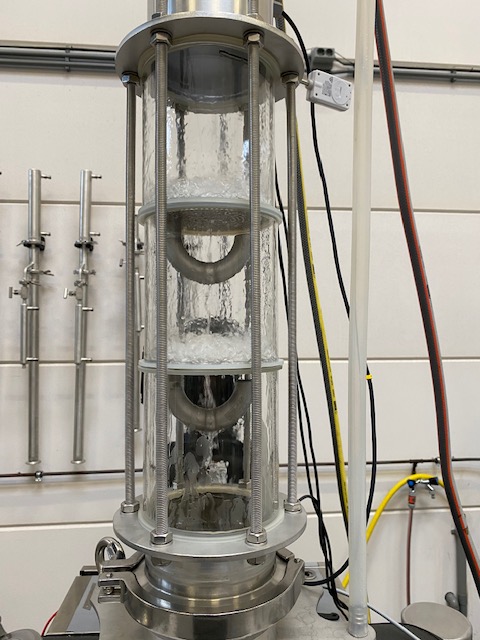
A grain mash, a botanical distillation and a neutral-spirit run do not leave identical residues. Check the boiler, column, packing, drains, transfer path and seals that contact the product. Identify where solids, oils or deposits can remain.
Routine rinsing can form part of the process, but clear rinse water alone does not demonstrate that every relevant residue has been removed. Define what a satisfactory result looks like and how it will be checked.
Stainless steel and cleaning chemistry
Stainless steel is widely used in hygienic processing, including systems designed for detergent-based cleaning. There is no general rule that detergents must never be used on stainless steel. Compatibility depends on the material, chemistry, concentration, temperature, time and other wetted components.
For example, Alfa Laval describes stainless-steel brewery CIP equipment controlling cleaning temperature, flow and detergent concentration. That illustrates the principle of a defined process; it is not a cleaning recipe for an iStill. Read the equipment manufacturer’s description.
Copper contact needs its own instructions
Copper is reactive and its surface changes during use. Describe those changes as oxidation or corrosion rather than treating them as iron rust. Obtain the cleaning and inspection instructions for the actual copper component, including any limits imposed by seals, packing or adjoining materials.
The copper and stainless-steel comparison explains why construction material and deliberate copper contact are separate equipment decisions.
Check the next product, not only the previous run
A gin-to-vodka changeover is a useful example. Botanical carryover can matter even when the next run uses the same still correctly. The cleaning procedure should cover the relevant contact path and include a check appropriate to the next product.
Record what was run, which cleaning procedure was used, its completion and the inspection or product check. Repeated production of one recipe still needs a suitable cleaning schedule; repetition does not establish that residues can be ignored.
Use CIP as part of a defined procedure
Cleaning-in-place describes cleaning through the installed equipment rather than dismantling every part. Coverage, flow and drainage matter. The existence of a CIP feature does not establish that every residue will be removed by a fixed five-minute cold-water cycle.
For current equipment and operating instructions, use iStill customer support. Include cleaning and changeover time in your capacity plan, and plan physical access through the distillery layout.