More possibilities. One clear process.
The most useful question is not how much flavor you can pull from an ingredient. It is which part of that ingredient belongs in the finished drink. Extraction, redistillation and blending give you different tools.

An extract and an essence are not the same ingredient.
Extraction can bring color, aroma and nonvolatile material into the liquid. Redistilling an extract creates a different ingredient: a clear distilled essence that leaves much of the nonvolatile material behind. University uses this distinction to explain why a process that works for one fruit can need another stage for the next.
Odin's development story is instructive. Strawberry extraction gave an attractive result; applying the same enthusiasm to blackberry brought excessive tannin. The aroma was promising, so the team explored redistillation instead of assuming the ingredient had failed. The lesson is not a universal recipe. It is to select a product format based on what the ingredient actually gives you.
Where iStill fits.
An optional Extractor and a suitable iStill setup let you explore those two routes: make an extract, or develop a distilled essence from it. iMini supports smaller trials before you commit a production batch to a new ingredient.
A repeating extraction loop.
- Vapor rises from the boiler.
- A condenser turns it back into liquid.
- Liquid passes through the separate ingredient chamber.
- The chamber fills and siphons back into the boiler.
Alcohol strength is an extraction choice.
Water and ethanol do not dissolve every compound in the same way. Changing their ratio changes the extraction environment and can shift what you collect. The initial charge strength is therefore part of the recipe, alongside ingredient preparation, contact and the number of extraction cycles.
The recirculating Extractor condenses vapor into liquid, passes that liquid through an ingredient chamber and returns it to the boiler. Ingredients are held outside the boiling charge. That is a different process from leaving them in the boiler or exposing them only to vapor, and it gives you another way to investigate heat-sensitive or intensely flavored ingredients.
Where iStill fits.
Compare solvent strength and extraction approach in documented trials. Specify the appropriate Extractor format and compatibility for your equipment. Its purpose is another controllable tool, not a promise that every ingredient can use the same method or settings.
Their ambition. In the glass.
The producers, the products and the recognition they have earned.

Pegasus · Minty
98 points · 2025 Best Liqueur
Beverage Testing Institute · 2025
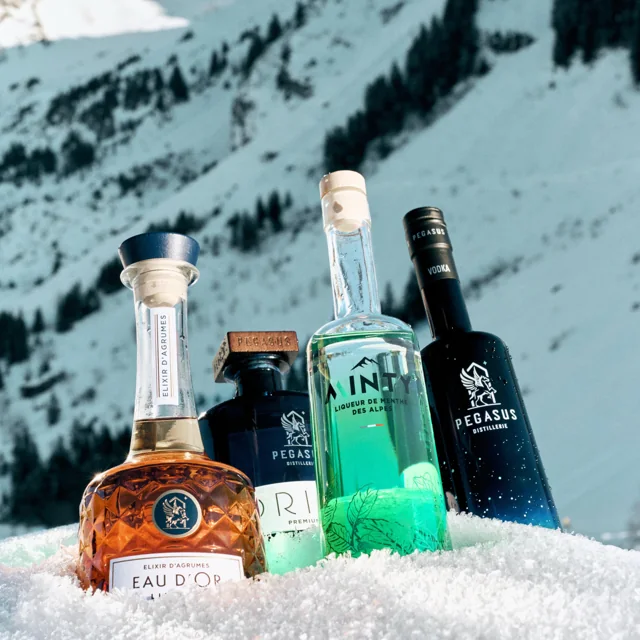
Pegasus Distillerie
From iMini trials to three production hybrids.
Burgundy, France · Customer interview, 2026

Fowey Valley Distillery
From a restored orchard to a from-scratch spirits portfolio.
Cornwall, UK · Founder interview, 2023
The finished formulation is the product.
A concentrated extract can taste exciting and still need work as a bottled liqueur. Sugar affects sweetness and texture; dilution changes alcohol strength and solubility; blending changes balance. Evaluate the complete formulation at the strength and temperature in which it will be sold or served.
Look at clarity, aroma and stability together. A clear distilled essence and a colored extract may create different presentation and storage considerations. Record ingredient additions, blending sequence and the finished evaluation, so a successful development sample becomes a repeatable product rather than a one-off result.
Where iStill fits.
Keep extraction and distillation records linked to the downstream formulation. Equipment repeatability helps create consistent ingredients, while your blending, proofing and release checks establish the consistency of the final drink.
Let creativity grow without overwhelming production.
A wider portfolio increases more than the number of recipes. It adds ingredient storage, different batch sizes, cleaning and scheduling decisions. A seasonal botanical release can be commercially attractive, but the working week still needs space for your core products.
Pegasus shows the value of connecting development and production. In its 2026 interview, Maxime described starting with iMini trials and growing into production on an iStill 500 and two 2,000-liter hybrids. Its portfolio includes vodka, gin and liqueurs. The story illustrates a flexible route to growth, while the product decisions and market work remain the producer's own.
Where iStill fits.
Compare the utilization of your main still with a smaller development setup and optional extraction capability. Design Studio helps compare the equipment; a discussion with the team helps align it with the whole portfolio and its changeovers.
Different tools. Informed choices.
Traditional equipment can make exceptional spirits. Compare the actual process and control you need, rather than a material, a shape or a headline.
| Decision | What to consider | The iStill approach |
|---|---|---|
| Ingredient contact | Maceration, boiler infusion and vapor infusion expose ingredients to different contact and heating conditions. | The optional Extractor adds a recirculating liquid-contact route with ingredients held outside the boiling charge. |
| Product format | An extract retains a different mix of material from a redistilled essence. Neither is universally the better choice. | Develop and compare both routes with a suitable still and Extractor configuration. |
| Scaling the range | Buying another production vessel is not the only response to a growing number of products. | Assess development capacity, batch sizes, extraction options and changeover scheduling together. |
“It is so easy to operate and the taste is great.”Build your setup.
Explore the equipment, then compare sizes and options in Design Studio.
Questions worth asking.
Can I make both colored extracts and clear essences?
Those are two routes covered in the Extractor lessons. Extraction produces an ingredient with its own color and nonvolatile material; redistillation selects a different, clear ingredient. Develop the appropriate route for the fruit or botanical and confirm equipment compatibility.
Does the Extractor guarantee a faster process for every ingredient?
No single result applies to every ingredient. The archive includes development examples, but loading, preparation, solvent strength and the desired endpoint matter. Use smaller trials to establish your own method and cycle.
Why do I need to test after adding sugar and water?
The finished formulation can behave and taste differently from the concentrated extract. Evaluate balance, clarity and stability after blending and proofing, and document the process needed to repeat it.
Go deeper. Learn from the source.
This guide draws on Odin’s teaching, the iStill archive and firsthand distillery interviews. The online University is free and open to everyone.
Explore the lessons, articles and tools 9 ↗
- Extractor in Practice: Extracts, Essences, and Solubility Control ↗University
- Odin on Inventions: The Extractor Story! ↗iStill Blog
- How to Make Peachcello Liqueur! ↗iStill Blog
- Extractor Fundamentals: Soxhlet Loop for Scalable Extraction ↗University
- Boiler vs Vapor Infusion: Flavor Intensity and Overcooking Risk ↗University
- Gin Production Mistakes: Myths and Cloudiness ↗University
- How to Taste Fractions ↗University
- Interview with Maxime from Pegasus Distillery ↗iStill Blog
- Yearly production capacity calculator ↗iStill
Keep exploring.
Have a project in mind?
A first idea, a question or a detailed plan. We can start from there.