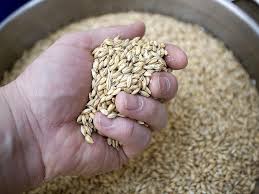
A grain-to-water ratio states how much water you use for a given grain weight. Express it clearly as liters of water per kilogram of grain. Then check the combined mash volume and mixing requirements against the equipment’s working limits.
Calculate the ratio directly
Divide water volume by grain mass. The original iStill example used 1,600 liters of water and 400 kg of grain: 1,600 ÷ 400 = 4 liters per kilogram. A 100 kg grain bill at that ratio would use 400 liters of water.
Four liters per kilogram is about 1.92 US quarts per pound, or 2.09 pounds of grain per US gallon of water. The original article’s two-pounds-per-gallon rule is a rounded approximation when the gallon is a US gallon. State the convention whenever converting; US and imperial gallons differ.
What the original examples show
The August 2022 article describes several loads for the iStill 2000 setup used at the time. With 1,600 liters of water, its 375 kg example corresponds to about 4.27 L/kg; 400 kg gives 4 L/kg; 440 kg gives about 3.64 L/kg.
Those figures compare water-to-grain proportions. They do not establish the allowed fill or mixing procedure for every machine. Adding grain changes the occupied volume, and different cereal bills behave differently. Use the current instructions for your vessel, agitator and associated equipment.
The ratio does not guarantee a fermentation yield
Water and grain mass are inputs. Actual sugar extraction depends on the malt, other cereals and mash process; the fermentation then determines the measured final result. Keep the original article’s gravity and alcohol figures attached to those examples instead of treating them as a universal output table.
Record the actual grain bill, malt analysis, water addition, mash volume, measured gravities and fermentation result. Compare changes one at a time where practical. Read how to evaluate two-row and six-row malt for the ingredient side of the decision.
Connect mash loading to the production schedule
A higher grain load is useful only if the equipment can mix, transfer and process it appropriately and the resulting spirit meets your target. Compare accepted output and the work required, rather than the grain weight alone.
The whisky guide connects mashing to fermentation, distillation and cask filling. For equipment, compare the Masher with a configured NextGen workflow. If one vessel performs several stages, include its occupation time in the plan.