From now on, you can apply to receive award appraisal from none other than Mr iStill himself! Using his unparalleled expertise, Odin can help you to elevate your spirit to the highest level and dominate the award shows. How does it work exactly? What bang do you get for your buck if you participate? Take a look at the example below:
Management Summary:
Customer: Classified
Goal: Customer wants to produce a gold-standard potato vodka
Tool: Odin’s Holy Trinity of Distillation
Current score: No score due to too many mistakes
Potential score: Gold, after Recipe Improvement
Summary: Too many fruity flavors at the front, too much flavor in the middle, strong back-end afterburn in throat
Odin’s Holy Trinity of Distillation (Explanation):
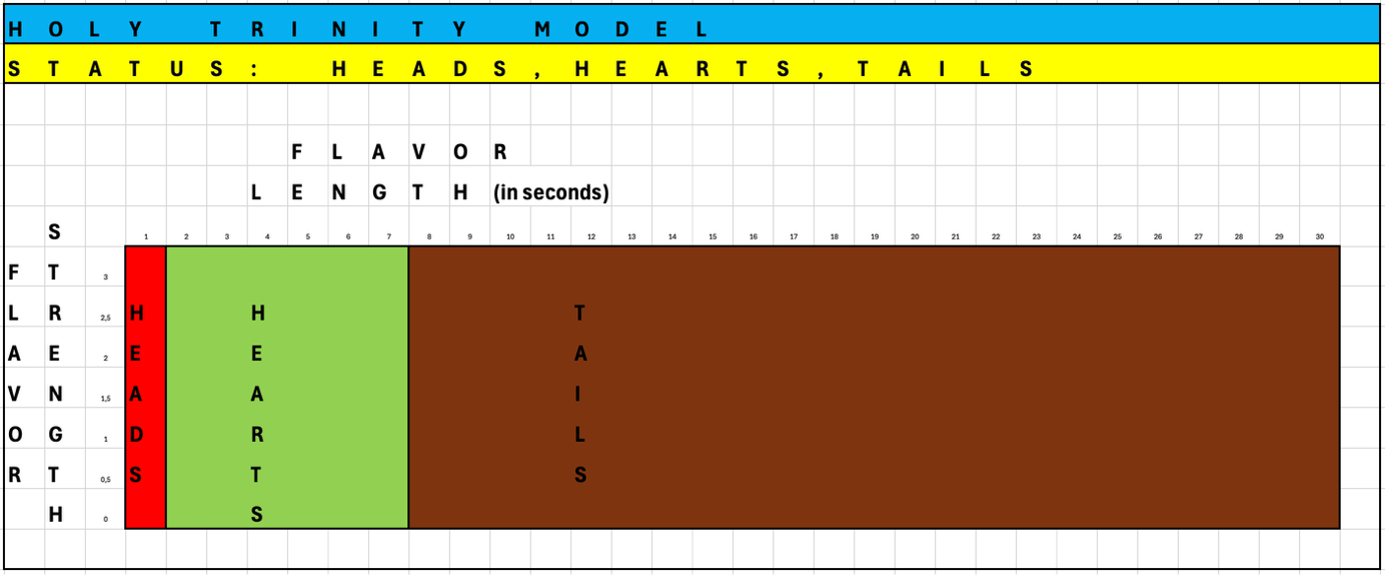
Odin’s Holy Trinity of Distillation distinguishes between heads smearing, hearts, and tails smearing. The heads smearing can be tasted in the first second after swallowing a sip. The hearts can be tasted during seconds 2 until 7. The tails smearing can be tasted from second 8 onwards.
As a general rule-of-thumb the heads smearing attributes up to 30% of total flavors, while the tails smearing contributes up to 50%. Only 20% of flavor associates with hearts. This teaches us how important heads smearing and tails smearing are. Making mistakes here seriously screws up your effort. Winning a gold medal with a drink that has a flavor profile that is off is all but impossible.
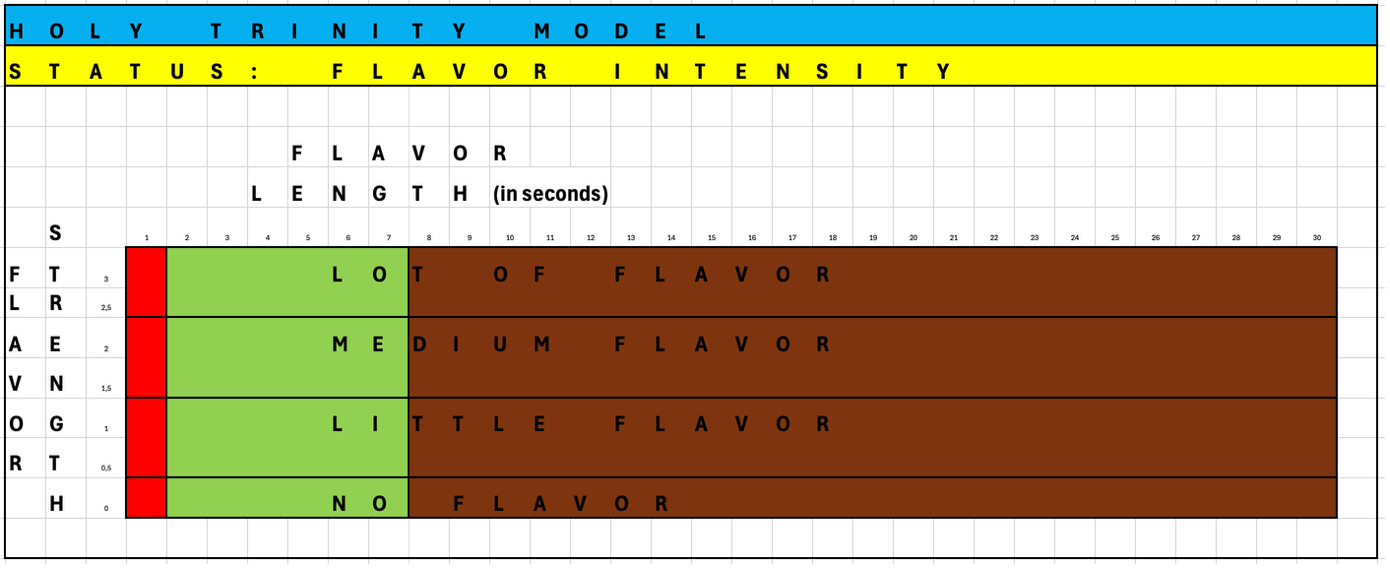
Odin’s Holy Trinity of Distillation distinguishes between “no flavor”, “little flavor”, “medium flavor”, and “a lot of flavor”. After first assessing how long the flavors last, now take a second sip, wash your mouth with it, swallow, and assess – with your mouth closed – what flavor intensity you get during the first second, from seconds 2 until 7, and from second 8 onwards.
In the representation above the flavor intensities are maximized. In reality flavor strengths are lower for vodka and higher for whisky and rum. Not every color should be of the same intensity. In fact, great product usually has an on-ramp and an off-ramp. A slightly lower “red” and “brown” score, relative to the flavor strength of the hearts.
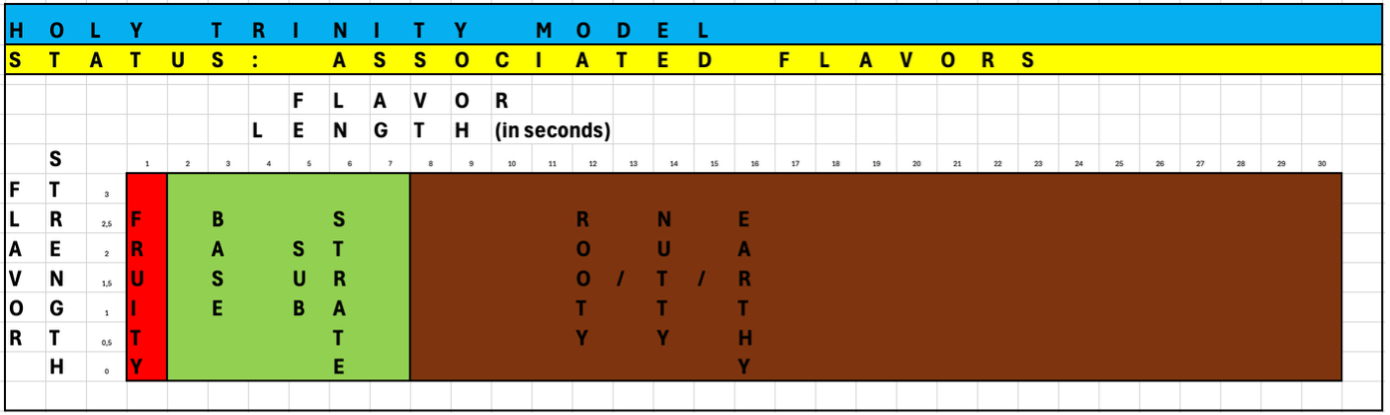
The first second of tasting reveals the fruity flavors. Some associate these fruity flavors with sweetness. The taste during seconds 2 until 7 lets you discover the base substrate flavors. In a rum, this is where you taste the molasse. In a whisky, this is where you should taste the grains the spirit is made from. In a gin, this is where you find the juniper and coriander. The taste from second 8 onwards reveals rooty, nutty, and earthy flavors. In for instance a single malt whisky, this aftertaste can last up to 30 seconds. Of course a vodka should not have an aftertaste. And a brandy should deliver on fruity flavors, specifically.
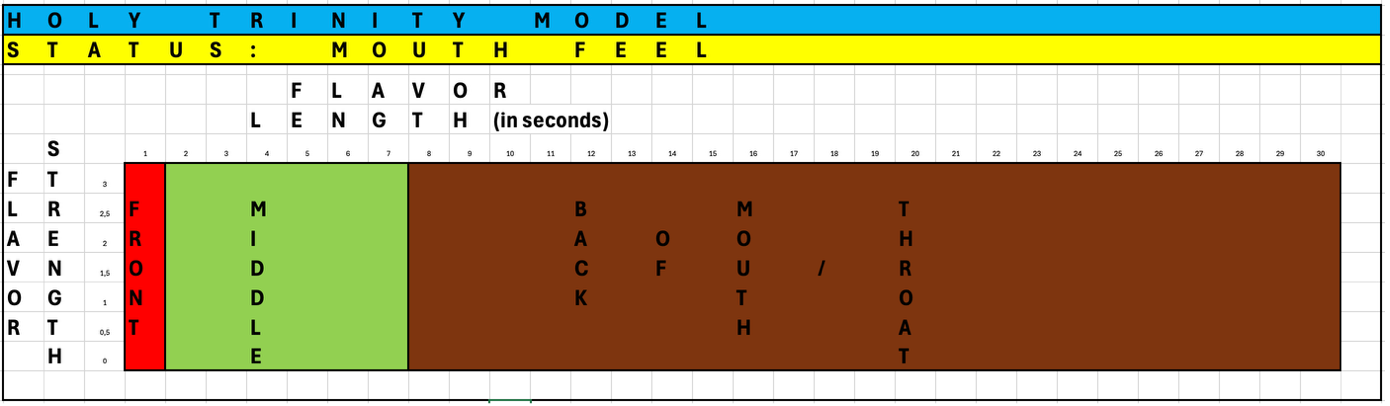
Finally, the heads smearing and fruity flavors are tasted in the front of ones mouth. The hearts associated flavors, that one tastes from seconds 2 until 7, hit in the middle of the mouth. The tails smearing and rooty, nutty, earthy flavors, that come over after second 8, are tasted in the back of your mouth and in the throat.
Voila, Odin’s Holy Trinity of Distillation teaches us how to taste! A spirit can provide flavors in three dimensions (heads, hearts, tails), that can be tasted on different time-slots, in different parts of your mouth, and that have a specific flavor strength (none, light, medium, heavy) and flavor qualification (fruity, substrate, rooty & nutty flavors). Now, let us apply what we have learned to the potato vodka at hand.
Odin’s Holy Trinity of Distillation (Application to Vodka):
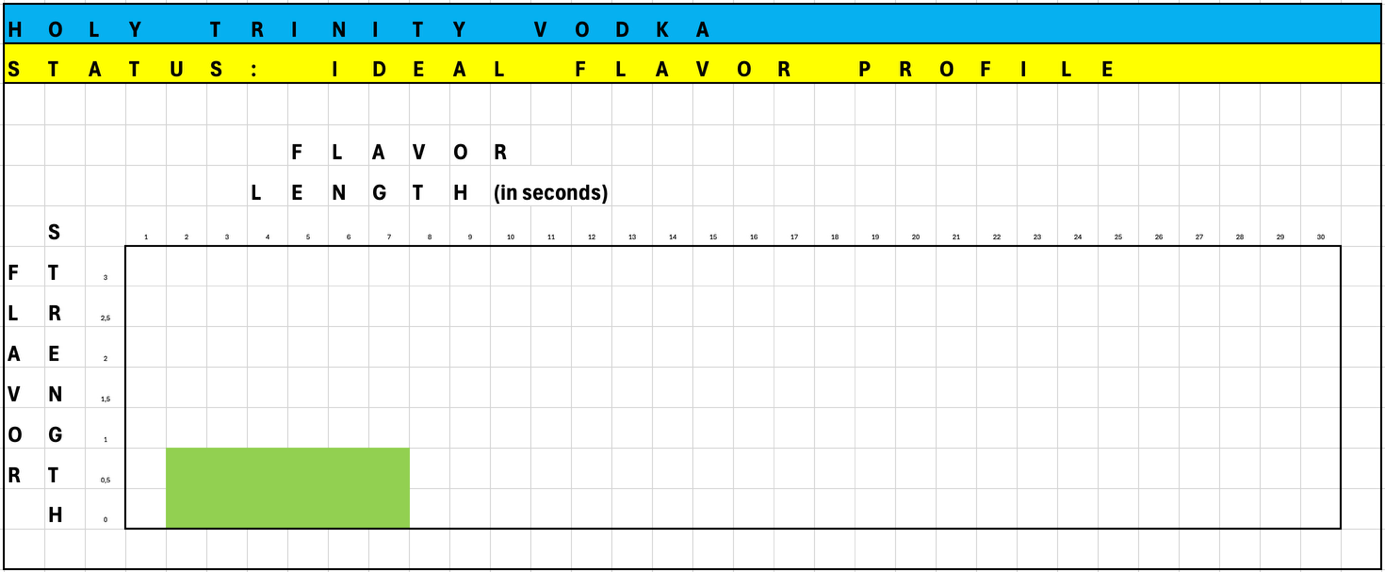
Vodka aims at bringing a neutral flavor profile to the market. There should be no heads smearing and there should be no tails smearing. A great vodka scores zero on heads and tails, and only a low flavor strength in hearts (score: 1). Fruity flavors and rooty, nutty, and earthy flavors have no place in a well-made vodka.
The taste sensation should take place from seconds 2 until 7. Vodka is tasted in the middle of the mouth, on the top of the tongue. The low taste intensity should be just enough to establish if this vodka is made from wheat (neutral), rye (some spiciness), or potatoes (smooth and creamy mouth feel).
Odin’s Holy Trinity of Distillation (Application to Customer Sample):
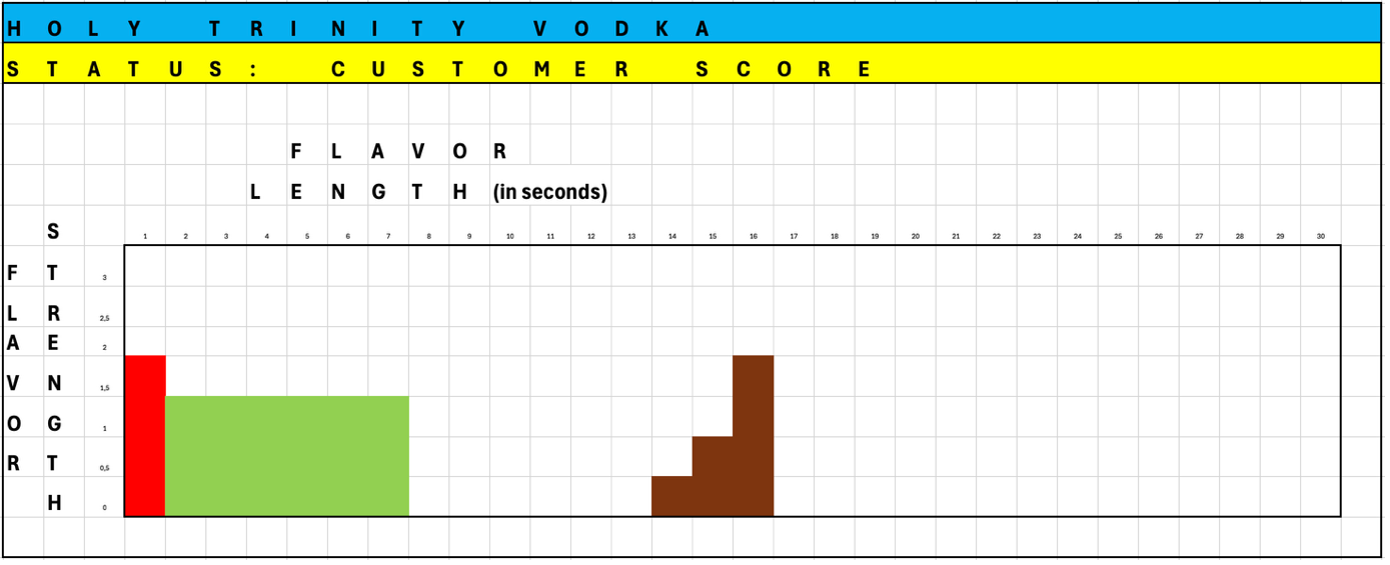
The customer’s potato vodka has medium strength fruity flavors, easily detectable during the first second of tasting. This potato vodka has a low to medium strength in potato flavors between seconds 2 and 7. During seconds 14, 15, and 16 a strong aftertaste builds up in the throat.
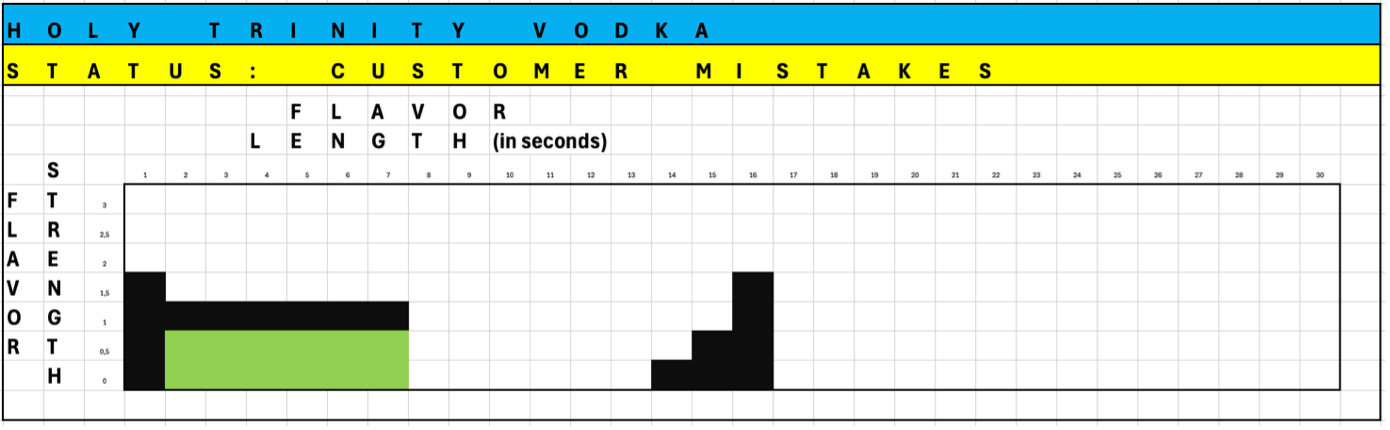
The potato vodka’s mistakes are high-lighted in black in the representation above. As all dimensions are compromised, relative to the optimal flavor profile for vodka, the current result does not deserve any awards. Mind you, this potato vodka might get an award, as the award industry likes to incentivize its customers to participate as often as possible (as they then pay as often as possible), but a spirit that has not even one dimension right, is simply and plainly wrong. And Odin does not hand out awards just for effort.
What is deserving of a bronze medal? At least have one dimension right. A silver award? Please make sure you get two dimensions right. A gold medal? Only when you score all dimensions correctly. Now, let’s assess the mistakes in the potato vodka more in depth:
Mistakes
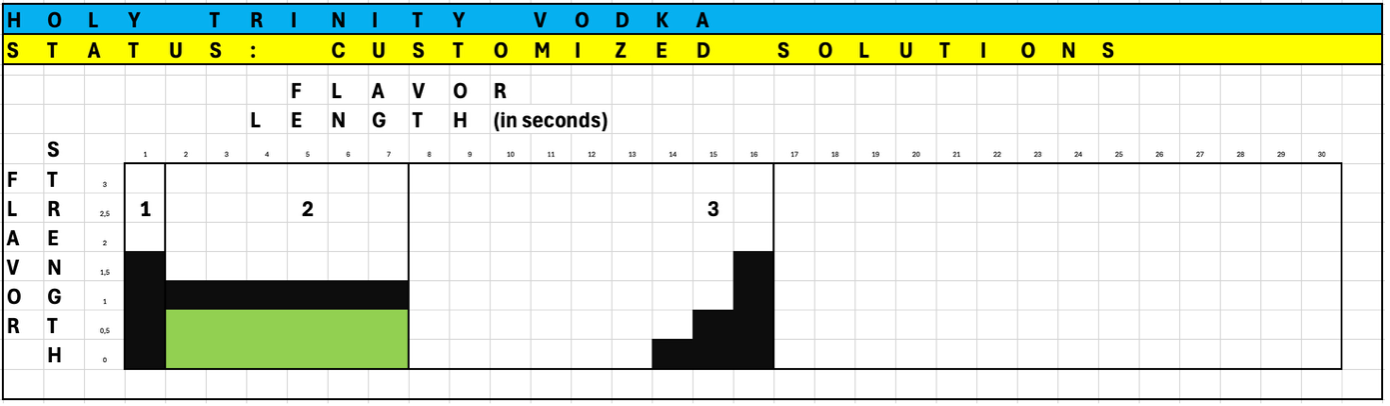
Dimension 1, the heads smearing, scores way too high and needs to loose 2 base points. At the moment the potato vodka has lots of fruity flavors that make it more like a potato brandy than a vodka.
The fruitiness destroys the neutrality and makes it more difficult to taste the potato flavors, that normally reside in the middle, as the first dimension overpowers the hearts part of the drink. Silky, smooth potato flavors are therefore replaced by sharp, almost harsh front-end notes. Overall, the flavor strength in dimension 2 is a bit too high.
The third dimension kicks in after 13 seconds. It is more an afterburn than an aftertaste. It hurts the throat, resulting in a raw experience, associated with cheap instead of hand-crafted, high-quality spirits.
In its totality, we see a inversed on-ramp and off-ramp. Dimensions 1 and 3 are stronger than dimension 2. Please remember that heads and tails already are higher in flavor count, as – together – they provide 80% of flavor.
Recipe Improvement (a summary only):
Outside of the scope of this Award Appraisal, but inside the scope of our Recipe Improvement Consultancy, we established for this specific customer that the potato vodka suffered from:
- Too high specific gravity of the worth;
- The wrong yeast;
- Out of range temperature of fermentation;
- Out of range pH of fermentation;
- Yeast stress due to excessive osmotic pressure;
- Out of range time of fermentation;
- Wrong procedure and settings for stripping run;
- Wrong procedure and settings for finishing run;
- Wrong vapor speeds;
- Wrong cut points.
Solutions (a summary only):
The above 10 points were established after the customer informed us on his protocols. As mentioned before, that is not part of Award Appraisal, but it belongs to the follow-up step, where we help you improve your recipe.
After the customer informed us on his protocols, we evaluated them, and confronted them with our findings within the Holy Trinity model, as presented above. We then helped him create a gold-standard, award winning potato vodka by introducing:
- A mashing protocol that delivers an 8% instead of a 10% strong mash;
- The right yeast for the job;
- Correct fermentation temperature ranges;
- Correct fermentation pH ranges;
- Cleaned and peeled potatoes to bring down (with step 1) osmotic pressure;
- Shortened fermentation time (for less flavor in the second dimension);
- New procedures and settings for the stripping run;
- New procedures and settings for the finishing run;
- Correct vapor speeds, optimized for vodka production;
- Correct cut points for less heads smearing and less tails smearing.
Interested to learn more? To become a better distiller? To improve your vodka, gin, brandy, rum, or whisky? Do you want to become the best distiller you can be and win the awards to prove it? Then please contact us. The above Award Appraisal can be made for any drink, including yours. It costs EUR 1.250,-. Take a look at the link underneath, if you want to participate!
But wait, because there is more!
Not all spirits are created equal. But by offering you a methodology to improve, you get the shot at greatness you and your product deserve. Not just by winning awards, but via participation in Odin’s Spirits. Odin’s Spirits is a new initiative, where our founder and CEO works with you together to make a special edition of your drink. This drink, if it is truly the best in the world in its class, is eligible for international distribution via our network! First release is in the making. What it will be? A vodka that scores 99 points at IWSC!
Link to Odin's Consultancy form: https://forms.gle/DKxZw6XHZFecctEk7