As an introduction, please read: https://istillblog.com/2024/10/16/making-wood-stoves-great-again/
Some additional observations. After 5 hours of burning wood in the stove, it starts to get warmer in the room. It seems that the stones have reached their maximum heat storage capacity … and that means from now on: energy in is energy out. With the "battery" full, the stove will operate as a normal convection wood stove again. Almost. It continues to use less wood (and air) and runs more efficiently. The "fuller" the stones are with heat, the more efficient the wood combustion in the actual stove is. So even now: perfect combustion, maximum efficiency (hence the heating of the room), and minimization of PAC production. The stove becomes the generator, the stones become the battery.
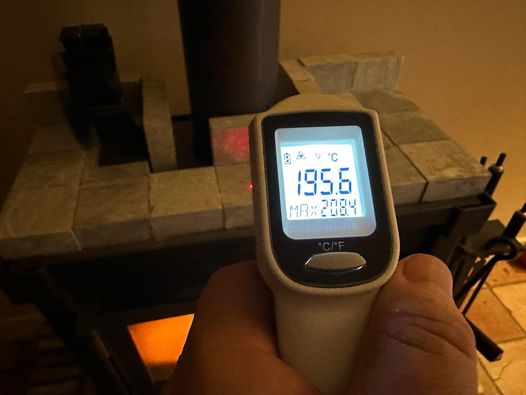
The stones radiate for about 6 hours after the fire has gone out and are still hand warm. It was 22.5 degrees Centigrade in the living room all night and morning. When I got home this afternoon at 6:00 PM, after work, it was still 21.5 degrees. Without the heating on. Simply as a result of the stove, which I stoked up the night before. It is now on again. I measure stone temperatures of about 140 to 195 degrees. 140 if you stoke a bit less hard and 180 to 195 if you stoke harder. In practice, this means a maximum energy storage capacity of 70 kWh, a minimum energy storage of around 40 kWh, and an average storage of approximately 50 to 60 kWh.
What's next? Well, next is an upgrade. By putting the soapstones in the upright position, the stove can hold many more. How many more? Instead of 24, it can now hold 52 stones. That's 60 kilo's of soapstone, with a total energy holding capacity of 100 to 120 kWh! In other words ... to be continued.