Introduction
Perforated plates and bubble cap columns got me thinking lately. An not just thinking, as we did a lot of testing on 'm as well. Did that result in any new insights, Odin? Well, it did, so allow me to share some thoughts, some observations, and some explanations. It will change your ideas on how traditional distillation columns work and it might influence your future decision making ... But first, before we dive in deeper, an introduction to reflux, distillation columns, perforated plates, and bubble caps.
What is reflux?
When distilling, you bring liquids to a boil. The gasses rise up into the distillation column. Part of these gasses, either intentionally via a column cooler or dephlagmator, or unintentionally because the column gets cooled by the colder outside air around it, turn back to liquid phase and fall or trickle down that same distillation column.
This returning liquid is called reflux. When a column cooler is actively used, reflux is created intentionally. This is called active reflux. When reflux is simply generated unintentionally, because the still sits in a colder environment, well, that kinda reflux is called passive reflux.
Reflux that is not intentionally managed is passive reflux. Passive reflux is, in this case, no more than a total system inefficiency. Reflux that is created intentionally can be used in certain types of distillation columns to further fortify the output. That's a good thing, if you want to be able to control the ABV of the spirit that you are producing. Higher proof output - in general - results in cleaner spirits and in a better separation of heads, hearts, and tails. So ... active reflux serves a distillers goal, where passive reflux is just an inefficiency.
Wat is a distillation column?
A distillation column is the part of a still that manages the gasses (rising up from the boiler) and the reflux trickling down from either the column cooler or the cooler walls of that column. The reflux is either used to create a redistillation event in the column, resulting in higher proof, or it is simply passively returning to the boiler. In all situations - fortified or not - the final gas stream nearer to the top of the column is presented - via a horizontal lyne arm - to the product cooler, so that these gasses are returned to a (stronger) liquid form.
A column that does not manage reflux actively we call a potstill column. A distillation column that does actively create reflux can basically use two technologies to catch and redistill the this reflux. First, there is the new technology of packed columns, where the reflux is distributed on a huge surface area for a high exchange rate between lower boiling point alcohols and factions (that travel up as gasses) and higher boiling point alcohols and factions (that travel further down as reflux). This more modern approach is both more efficient and effective.
The second, more traditional type of active reflux management column is called a plated column. Here, plates sit horizontally in the distillation column. The plates catch the reflux from above and let the gasses pass that rise up from under the plate. On the plate, the gasses and reflux mix and mingle, and exchange lower boiling point alcohols and factions (that travel upwards as now enriched gasses) and higher boiling point alcohols and factions (that travel downwards as now more alcohol-depleted reflux). There are two kind of plates: perforated plates and bubble cap plates. Let's dive into their differences before I share some new and very interesting insights with you ...
What is a perforated plate?
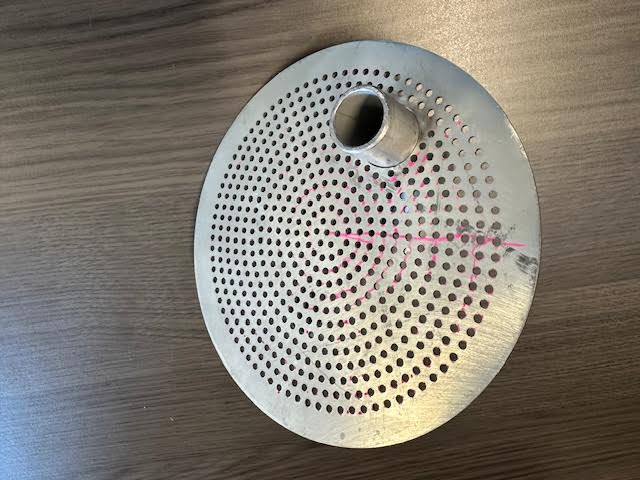
It basically is what it says it is. A plate that is positioned inside the distillation column and that is full of small holes. The plate trap the reflux, that comes from above (from the column cooler), so that a liquid bath forms. The gasses, that rise up from the boiler, use the holes to enter the liquid bath. In the liquid bath gasses and liquids meet and mingle, and exchange alcohols and factions of water and alcohol. As a general rule, the higher boiling point alcohols and factions move downwards. Reflux is returned downwards with a downcomer and also seeps through the holes back to the boiler or onto the next lower plate. That reflux is now lower in ABV, while the rising gasses improve in alcoholic strength.
Perforated plate with one bigger hole to feed the downcomer ...
What is a bubble cap?
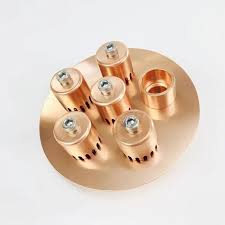
A bubble cap also sits on top of a plate that's normally welded horizontally in the distillation column. Gasses rise up through one big central hole in the actual bubble cap. The mushroom-like structure bends the gasses downward, where they meet the reflux from the column cooler. Gasses and liquids meet and mingle, and the now higher proof gasses rise up further, while the depleted reflux flows over the mushroom back to a lower plate or the boiler via the downcomer only.
Bubble cap plate ...
Thoughts
Bubble caps have a fixed liquid bath above the plate. This means that even when we stop distilling, the reflux that assembled on the plates stays there. Perforated plates have a less stable liquid bath. When the distillation run stops, or when we lower the power input, or decrease the amount of reflux we produce, the reflux on the plate starts to fall through the holes, so that the perforated plate drains.
Given the more stable liquid bath, the bubble cap still is considered to have more separation power and to be a more efficient tool in the distillation process. That thought makes sense, as perforated plates "weep", that is to say: part of their reflux escapes downwards through the holes in that type of plate. That feels like a loss or inefficiency that results in less reflux being processed and less exchange taking place. It does not only feel that way, it is - by the craft distilling industry - considered that way! Bubble cap plates are more efficient. Bubble caps are the preferred choice.
Observations
When we look at the distillation process taking place in a glass column, we observe the following:
- Perforated plates do weep: we see reflux being drained via the holes as well as via the downcomer;
- Bubble cap plates do not weep: reflux is moved downwards via the downcomer only;
- We see more downward pouring liquids, polluting the space directly under the perforated plate;
- We see less downward pouring liquids polluting the space directly under the bubble cap plate.
And this all makes perfect sense, if we follow the reasoning presented above. Bubble caps offer better separation and efficiency, right? They don't weep so ... do not disturb the space directly under the plate. Well ... hold on to that thought, as we share the very interesting additional observations that we made:
- Perforated plates have a very stable liquid bath above the plate, with very limited boil-up;
- Bubble cap plates have a very unstable liquid bath above the plate, with LOADS of boil-up;
- Perforated plates create very small entrainment zones, so no liquids boil-up from one plate to another;
- Bubble caps create huge entrainment zones, where those liquids pollute a higher plate.
And that does not make any sense at all! Bubble cap plates should offer a more stable liquid bath above the plate, and should offer more separation power more efficiently, because they don't weep. But when we look at the actual activity above the plate, it becomes clear that a lot of the liquids are just thrown high in the air. Contrary to current belief, it is the perforated plate that offers a very stable liquid bath, where gasses and reflux can meet and mingle without too much disturbance.
As less entrainment means less smearing, while a better exchange rate between various alcoholic molecules and water/alcohol factions results in a higher efficiency, could it be that the currently held beliefs in the industry are all wrong? Can it be that the perforated plate design simply outperforms the bubble cap plate design in both efficiency and separation power?
How would that be possible? Well, I have a few explanations, for you to consider, sumarized underneath. Please do understand that the differences between the perforated plate and the bubble cap, as it currently stands, is huge. A 5 inch diameter column with a perforated plate can easily handle 9 kW of power input. For the bubble cap to have a liquid bath that's at least a little less volatile, we need to cut power to 4,5 kW!
Explanation
The perforated plate design is actually better than the bubble cap design. And here are the reasons why:
- The many similarly sized holes in the perforated plate design allow for a more evenly distributed gas release as well as a more evenly distributed gas pressure, relative to the bubble cap design, with its limited number, variable size vapor outlets.
- The small size of the holes in the perforated plate design results in more and smaller bubbles, and that gives better vapor/liquid mixing results than the bubble cap's much bigger gas release holes. Bigger bubbles have a bigger internal content relative to their surface area. And it is at the surface where lower and higher boiling point alcohols exchange phase. Bigger bubbles also move more liquid upward, leading to more disturbance above the plate ...
- Perforated plates do not bend or manipulate the gas stream, where bubble caps do. A full 360 degrees bend of the vapor trajectory, actually! Now, one might theorize that this bending costs energy and slows the vapors down ... but where does that energy go? And slowing vapor speeds by definition leads to bursts of micro-pressure building up in the gas trajectory right before the slow-down or bottle-neck. Actually, it is those bursts that further help create the disruptive volatility that we see on top of the bubble cap plate, but not on the perforated plate.
- If the excess volatility on the plate is inherent to the bubble cap design, let's understand that this volatility is much worse that the more volatile liquid states under the perforated plate. Why? Because the gas/liquid alcohol exchange takes place ABOVE the plate and not under it! A less disturbed environment is a more controlled environment, where a more perfect on-plate distillation cycle can take place.
- The perforated plate's volatility is directed downward, pushing back on potential upwards moving entrainment from the plate below. The bubble cap plate's volatility is directed upward, pushing liquid entrainment onto the next plate.
- And what if the weeping of the perforated plate is not an inefficiency, but rather a boost of overall efficiency? I think that the liquids that weep through the plate exert an under pressure or micro vacuum above the plate (especially when the downcomer has a waterlock to its design).
- So the bubble cap is NOT be the stable variant of the two plated distillation solutions. Instead, it is the relative open and even structure of the perforated plate that allows for an equilibrium to develop, that is maintained by both an micro vacuum under the plate, as it weeps, and an overpressure from the plate above, as that one drains.
- These under pressure and overpressure events lock the perforated plate's liquid bath in place. Where the bubble cap, with its fixed, "vapor flow preventing"-design, hampers that equilibrium to build. As in the bubble cap design no (minor) under pressure or (minor) overpressure is keeping the liquid bath in check, it's preventing that equilibrium to establish, thus CREATING (or at least allowing for) the disturbance we see on top of the bubble cap design, but not on the perforated plate!
Conclusion
Any distiller that wants to go for a plated column design better choose a perforated plate, as it is inherently better than the bubble cap design. How much better is the perforated plate? The perforated plate is twice as effective as the bubble cap plate.
The bubble cap plated column entrains to the extend that it floods at low power settings ...
A stable liquid bath, without entrainment or flooding on the perforated plate ...
www.iStill.com