Introduction
First principle thinking is a methodology that reduces reality to its basics. It aims to find the axioms on which the reality is based, often by discarding commonly helt believes or assumptions. Once - via reduction and deduction - the true building blocks of the applicable science are found in a given situation, technology, or industry, a process of rebuilding that situation, technology, or industry can take place. This rebuilding can take new forms and innovative ways while it recreates reality, simply because with the final and smallest building blocks in place, there is so much more freedom to recombine.
Example
A decade ago, one could often hear the following phrase in our industry: "A still needs to be made out of copper!" Is that an axiom or is it an assumption? The distinction is very important, because if we can reduce reality to the extent that it turns out that "copper" (a material) is unquestionably a condition for or a synonym to "distillation", than we learned something essential about still design, as that is based on a correct understanding of distillation.
It is of course very easy to assess that the phrase that a still needs to be made out of copper is not an axiom but an assumption. We can establish this, because distillation also takes place in glass or stainless steel stills. So there you have it: an example, in our industry, of an assumption that too often was used as an axiom. Why is that bad?
It is bad because when assumptions are seen as axioms, stills are designed on wrong principles, instead of first principles. And a wrong understanding of distillation by definition leads to sub-optimal still design. A better understanding of distillation is needed in order to allow the industry to develop better technologies for distillation. So ... what are the first principles of alcoholic distillation? First, let's dive into our goals, when distilling. Secondly, let's see if we can find some first principles ...
Goal of alcoholic distillation
The goal of alcoholic distillation is to:
- Enrich the end result in alcoholic percentage;
- Enrich the end result in flavor.
To keep this iStill Blog post clear, here, we'll first focus on the first goal of alcohol enrichment. Later on, we'll elaborate on flavor-enrichment. Probably in a different article.
First principles of alcoholic distillation
- Boiling a liquid creates gases;
- Cooling gases creates liquid;
- Gases have a lower density and tend to rise;
- Liquids have a higher density and weight and tend to fall;
- Gases are higher in alcohol than the liquid they are distilled from;
- Gases that are richer in alcohol, when cooled, shift back to liquid phase at that higher alcohol content;
- The phase-shift from gas to liquid and liquid to gas is pressure-dependent;
- An efficient alcoholic distillation cycle is better than an inefficient distillation cycle.
Boiling a liquid creates gases
From this first principle, we can derive that - in order to distill - we need to construct a vessel that can hold the liquids that we want to boil. It also becomes apparent that power management needs to be added to that vessel, so that the liquid inside it can be heated up and brought to a boil.
Both of the above principles ("we need a vessel", "we need to add power management to that vessel") are so-called derived principles; they follow from the first principle. Why is it important to understand that? For two reasons. First of all, I want you to take away from this that the goal of first principles thinking is not just to find those first principles, but to use those first principles to come to better decisions! First principles thinking is a verb, a methodology, not a goal, but a starting point!
Secondly, understanding how deriving principles are (or should be) grounded in first principles, makes us realize how easy it is to make mistakes when we are not guided by first principles thinking. If we wrongly think that the vessel is the ultimate prerogative, we might easily conclude that it is the goal, not the means. I'll elaborate on that a bit later in this article some more.
Cooling gases creates liquid
You can't drink gases, but we can consume liquids. So, if the production of gases is not the goal, but the production of alcohol-enriched liquid is ... then cooling gases back to liquid-phase is as important as creating them!
Deriving principles? let's give the cooling design as much attention as we give the vessel and power management. Especially given the next first principle ...
Gases tend to rise
The key word here is tend! In an open pot on a fire, gases just spill over and leave that pot vertically, horizontally, and diagonally. From this principle we can derive that the vessel for distillation is more than a pot. It needs to direct the gases upward, as that is away from the boiler. Or upwards and then sideways; again: away from the boiler.
Now, let's bring the previous first principle into play again, the one where I stated that cooling gases results in them collapsing back to liquid state. As liquids have a higher density (100x approximately), the phase-shift from gas to liquid creates suction. Cooling creates phase-shift that creates suction. It is the suction via the cooling principle that moves the gases upwards or upwards and sideways, away from the boiler!
Cooling is needed to guide gases in the right direction. The vessel that surrounds the gases that rise up serve the goal of maintaining suction. Constant suction, uninterrupted suction, if we bring first principle number 7 ( the phase-shifts between gases and liquids, and vice versa, are influenced by pressure) into play. See how all is connected?
See that not valueing one principle can have severe consequences for the optimization of the total distillation process? Another reason why first principles thinking should always and continuously allow us to question what we think and how we think.
Liquids tend to fall
As liquids are more dense and heavier than gases, well, they fall. How do we take advantage of this first principle? Well, it creates more understanding. Why do potstills have risers (that guide the gases vertically) and then bridges (that guide the gases horizontally)? Because if we cool gases back to liquids above the pot - and there is nothing between that liquid and the pot - these liquids simply fall back in the pot, nullifying the act of distillation one tries to perform.
When we start to understand that we need to get those now enriched liquids out before the fall back into the boiler, we are on our way to understanding alcoholic distillation. When we start to understand that liquids are the basis for the further enrichment of gases, we are on our way to mastering alcoholic distillation. The higher ABV liquids that we are producing can be seen as an intermediary state that we can further enrich!
And that brings us to first principles number 5 and 6 ...
Gases are higher in alcoholic content than the liquids they are boiled off from ... and maintain that higher ABV when cooled down
Principle 5 and 6 are at the heart of why we distill. It is the chemical basics that we put to work and take advantage of. The true first principles of distillation? Yes, in an important way they are. We want to create enriched gases from (enriched) liquids, and cool those enriched gases down to liquid-phase for consumption. We manage the other first principles in such a way that we optimize for principles 5 and 6!
Phase-shifts are pressure-dependent
The higher the pressure, the higher the boiling point of the alcoholic base liquid that we try to enrich. The lower the pressure inside the distillation vessel, the lower the boiling point. Higher pressure leads to less gas formation and more liquefaction. Lower pressure results in more gasification and less liquefaction. More variability in pressure results in more over- and under-pressure variability within the vessel that we are using for distillation.
Insufficient cooling, or a focus on boosting power management, results in the gases finding themselves in a higher pressure environment. The result? More liquefaction, and a less then optimal result.
A distillation that is in a constant and managed state of underpressure creates more gases and therefore more enriched liquids. It is a more efficient machine (if we can induce that vacuum at low energy spending). A distillation that is in a constant (and managed) state of overpressure creates less gases and so less enriched liquids and is therefore less efficient.
Yet, take into consideration that underpressure clusters boiling points of various components in the base liquid closer together. Vacuum stills are more efficient, yes, but they deliver lower proof and smear factions.
Overpressured stills are less efficient, but do deliver a higher proof result and beter separation, as boiling points of the various compounds in the original liquid decluster. The factions of the distillation run, as a result of the boiling points moving further away from one another, see a higher degree of separation and less smearing.
If there might be benefits and drawbacks from both over- and underpressured stills, let's focus on stills that do not - or cannot - build-up overpressure or a vacuum. It gives us a nice status-quo to start with. What is important though, is that the whole distillation device is designed in such a way that pressure variability is as small as possible!
Still design, insulation, and more all of a sudden become important. Constant vapor speeds are constant in pressure. And as pressure changes result in vapor speed changes, and vapor speeds are directly correlated to the flavor content and flavor consistency of the taste molecules that travel upwards with the gases ... vapor speed management (and therefore a still design that minimizes pressure variability) is key to distilling amazing spirits. But that's another topic, for another iStill Blog post. Expect more information on the first principles of flavor next week!
Efficient distillation trumps inefficient distillation
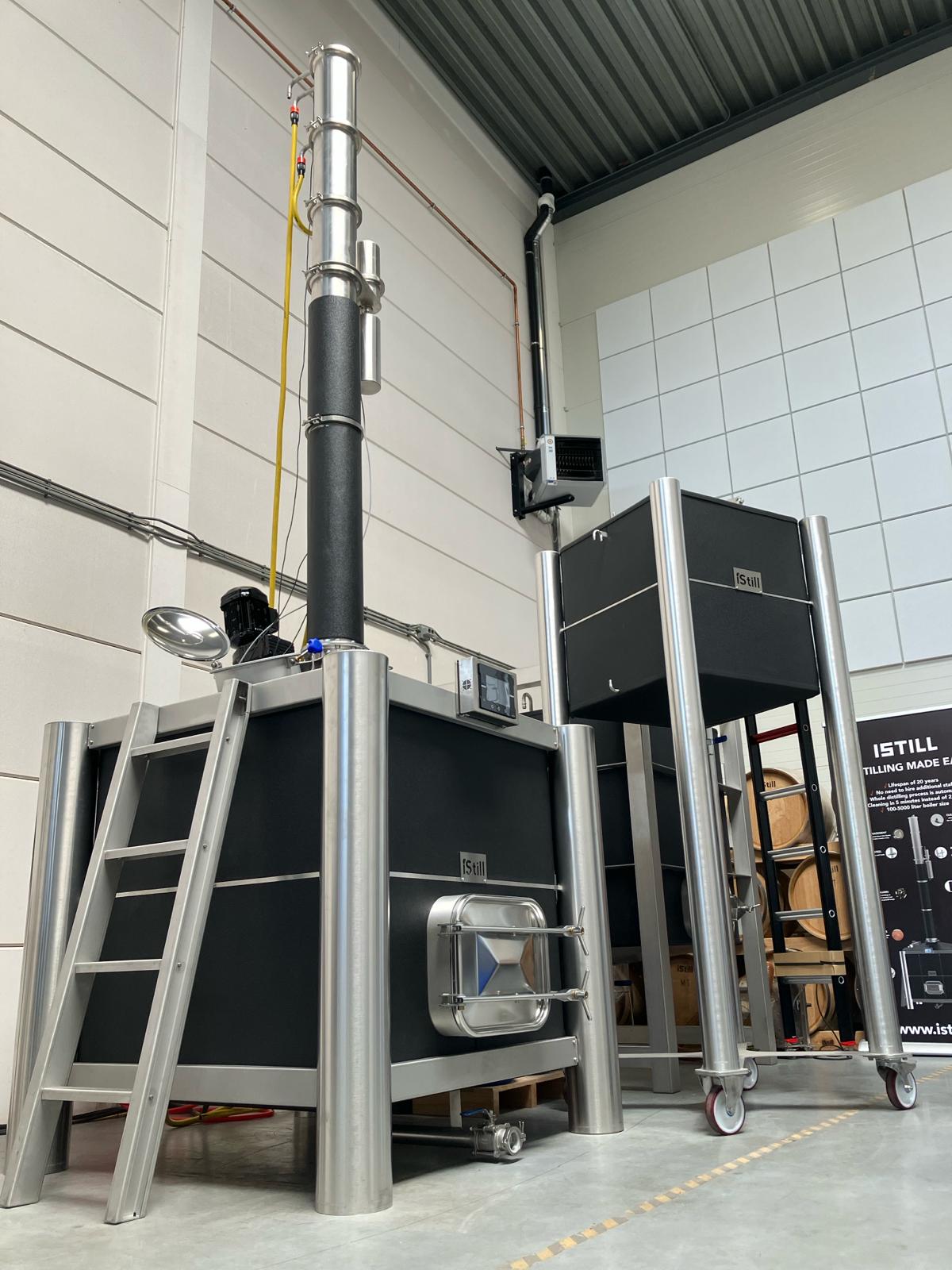
Maybe this is not a first principle, but it is a guiding principle, by which I mean that it helps us set a standard. Why are traditional stills not insulated? Because they were not designed using first principles thinking. Looks trumped functionality, as a result, and it comes at a huge cost in inefficiency.
Imagine us insulating that traditional column. What would happen? We'd see a 25% improvement in yield, in liters of alcohol produced per hour, at the same power input. This can teach us that the uninsulated column was 25% les efficient, so it resulted in cooling (from the outside-in), that - again - resulted in lower phase-shift temperatures for gases to collapse to liquids ... so more unintended reflux was created, falling back to the boiler and causing a de-facto non-distillation-act.
If we change something to a still's design, and it becomes more efficient, that means that we improved that still. iStills only use 25 to 30% of the energy a traditional still uses. That is because we use first principles thinking to create better tools for the craft distilling industry.
www.iStill.com