Introduction
The big boys do it, so the small ones should follow suite? No freaking way. Continuous distillation is an industrial process, optimized for the cost-efficient production of low to medium quality spirits. It is not a technology that is suited for craft distillers, as it won't grant them access to the same cost-efficiency gains, but it will deliver on sub-standard quality of output. Let's dive in deeper!
Continuous distillation: the technique
The word "continuous" says it all. Continuous distillation is a technique that constantly distills. Twenty-four hours per day, seven days per week. The fermenters, where a 7 to 8% whisky beer is made over the course of about three days, directly fead the continuous distillation column and the continuous distillation column processes all the wash that fermenter has to offer. Is the fermenter empty? Then another fermenter comes online, to ensure a continuous feed to the continuous still. The now empty first fermenter is refilled with fresh mash. Yeast is added to the grain/water-mixture, so that a new batch of whisky beer can be produced.
In general, the continuous still gets fed with beer in the middle and are heated from the bottom. Alcohol purification is achieved via bubble cap or perforated plates inside the column. Grains, water, and high boiling point alcohols (tails) move down. Ethanol and low boiling point alcohols (heads) move up. Usually, multiple take-off points are fitted on the column, so that specific compositions of hearts, heads, and tails can be collected.
Continuous distillation: the problems it solves
Continuous distillation is an industrial approach to alcohol production. It is a very efficient way to produce huge amounts of middle-of-the-road quality alcohol. What's great about it is that it knows no downtime. Contrary to pot or batch distillation, there is not refill, heat-up, clean-up, and discharge time.
Also, in a specific continuous distilling application that is called the Coffey Still, the beer is used as coolant, saving both on cooling water and pre-heating the wash prior to distillation. This double efficiency gain makes the continuous still, relative to traditional copper potstills, a very effective distillation device, that is hard to beat on production costs per liter of alcohol produced.
Continuous distillation: the problems it causes
In a pot or batch distillation technique, a boiler, that feeds the column, is filled with whisky beer. That batch of beer is processed completely. When all the alcohol is collected and strengthened by the column, the run is finished. The stillage, mostly water and spend grains and some tailsy alcohols, is cleaned out from the boiler. Fresh wash is added to the boiler. The boiler is brought to a boil again, and the cycle starts all over again.
Contrary to continuous distillation, batch distillation has a beginning, a middle, and an end. Contrary to continuous distillation, the output of batch distillation first produces heads, then hearts, then tails. As such, batch distillation is much better at separating out heads and tails than continuous distillation is. In vodka production, batch distillation creates a better, cleaner product, because the heads and tails smearing can be completely taken out, where - in continuous distillation - there's always going to be some heads and tails present in the end product, as the column is always fed with the same beer, that simply always happens to have some heads and tails present.
But there is more. Continuous distillation, as it works from one and the same substrate all the time, gives very limited control over smearing. The above paragraph mentions that vodka made on a continuous still is less pure than batch distilled vodka. But an inherent amount of smearing is always the case in continuous distillation, and it mostly depends on the beer that's fed into the system. In other words: when making taste rich spirits, like brandy, rum, of whisky, where the right amount of heads and tails smearing matters, continuous stills under-deliver. They have an amount of smearing that is a given, and that is very difficult to manage upwards or downwards. For that a laboratory is needed, where heads and tails can be extracted and re-assembled to create certain flavor profiles (e.g. via hydroseparation protocols in between two continuous runs). Yes, more plates can produce different outcomes, in terms of smearing, but a plate is a crude device for separation. Many, four or five at least, are needed to get to any differentiation as far as smearing is concerned. At the cost of creating a very high ABV spirit that is pretty tasteless.
Summary? Given the continuous feed of always the same product, continuous stills do not offer much control over heads and tails smearing, contrary to what batch distillation offers. Continuous distillation produces mediocre vodka and mediocre brandy, rum, and whisky efficiently.
Why continuous distillation sucks for craft distillers
Here's why continuous distillation sucks for craft distillers:
- Craft distillers can never outcompete Big Alcohol on cost price per liter;
- Instead, they must compete by bringing higher-quality spirits to the market place;
- A higher quality that makes up for the higher production costs;
- A higher quality that can only be achieved via batch distillation, and not via continuous distillation;
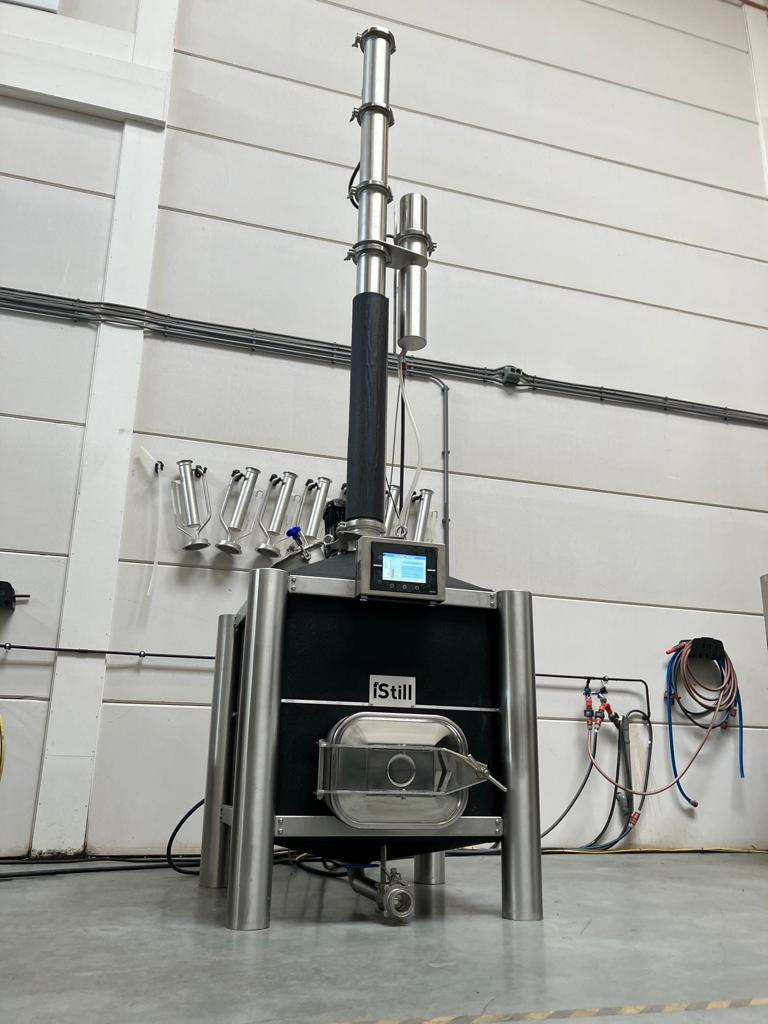
- Ah, and if you buy an iStill, you get even more control over flavor profiles;
- While saving 75% on energy costs, relative to other, more traditional batch stills;
- Yes, you read that correctly: iStills offer the quality of perfected batch distillation;
- At production costs lower than even the best continuous stills offer!
If you want to make the best spirits in the world, in the most repeatable and efficient manner possible, purchase an iStill.
https://istill.com/halloffame