The traditional role of copper in still manufacturing
Traditionally, copper plays an important role in still building. Originally, copper was available, affordable, and bendable. That's why traditionally stills were made out of copper.
Nowadays, copper helps solve issues Big Alcohol faces, but it comes with drawbacks. This blog post dives into the problem copper solves, the problems it creates, and the options iStill proposes.
The problem copper solves
When the industrial revolution and globalization hit the distilling industry, in the second half of the 19th century, it resulted in fewer but bigger distilleries. Bigger stills needed to be fed, as frequent as possible, with bigger, faster ferments. And bigger, uncontrolled, and faster ferments create off-flavors such as sulfurous compounds.
High, globalized demand asked for bigger and quicker ferments that resulted in higher sulfur content spirits. Sulfurous spirits aren't very drinkable. Luckily, though, the stills were made out of copper. Lucky why? Lucky because copper reacts with sulfur. The problem copper solves is that it takes away sulfurous smells and tastes. Copper stills turned out to be a great medicine for imperfect ferments.
The problems copper creates
Copper solves a problem, while creating a bunch of new ones at the same time. Here is a summary:
- Copper oxidizes and corrodes, so it needs to be replaced after 10 to 15 years;
- Copper oxidation and corrosion can contaminate your drinks;
- The oxidation and corrosion influence column vapor speeds;
- Copper is expensive;
- Copper has a high thermal conductivity, leading to lower total still efficiency;
- With a low rate of control over column vapor speeds and passive reflux;
- Copper columns need cleaning after every run, adding 2 hours to your work day.
- How do our designs help solve or prevent the problems copper creates?
- How does iStill help fix sulfurous drinks?
Here is a picture of the iStill 2000 and its column in potstill configuration ...
[gallery ids="12975,12974" type="rectangular"] Copper Catalyst Math Now, let's do the same calculations for a copper catalyst. First, we are going to take a good look at a copper spring filled catalyst, then we will do the math for our unique copper waffles. The copper springs we have on offer are 1 by 1 cm tall and wide. If we apply the formula, we can calculate that the inner surface area is 1*3.14*1 equals 3.14 cm2. But, contrary to a copper column, these springs sit inside the still. It's therefore not just the inside surface area that contacts gasses, but also the outside of the spring. This grossly doubles the surface are per spring to 6.28 cm2. We can now calculate how many springs are needed to create the same surface area as a copper column. Let's divide the total copper column surface area by the surface area of one spring. Here it is: 9,420 / 6.28 equals 1,500 copper springs. We only need 1,500 1*1 cm copper springs to have the same catalytic functionality as a complete copper column! And that's without taking into consideration that the springs are not perfectly round. Instead, they are made out of copper wire, which results in a corrugated shape that increases total surface area by 50%. 1,500 of our copper springs therefore surpass the catalytic functionality of the copper column by 50%!Just three bags (500 springs per bag) outperform a copper column by 50% ...
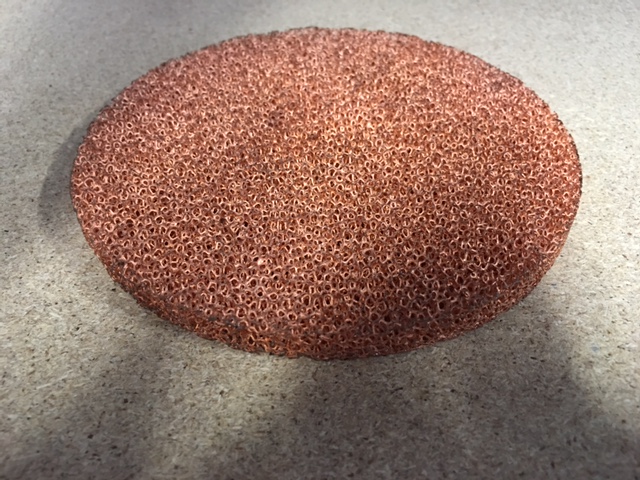
[gallery ids="12973,12976" type="rectangular"] Copper Waffle Math The copper catalytic waffle, that can be used in the iStill 2000, has a total surface area of 7,536 cm2. That is exactly 80% of the total surface are of the copper column calculated above. This means that if you add just two waffles to your (stainless steel) iStill 2000, you get 60% more copper surface are than a completely copper column.iStill 2000 copper waffle ...

www.iStill.eu