Introduction
Over the years, the iStill Team has helped hundreds of craft distillers by providing them with amazing stills, and industry leading trainings and workshops. But we have done more. We have for instance helped create over 200 recipes. How we help the craft distilling industry by designing recipes, is what this iStill Blog post is all about.
Rooted in theory
The customers goals are the starting point. What product does he or she want to make? Should it be bold in style or more pure? One, two, or three dimensional? Fruity or rootlike or nutty in character? Front of mouth oriented? Back of mouth, maybe? And - very important! - should the drink barrel age prior to bottling? Color, alcohol percentage, time to market, time in the barrel ... the list of questions to get started is long.
Odin's Theory of Distillation is always the starting point. The theory explains, in a very straight forward manner, how a recipe should be designed in order to reap the right tastes, intensity, and complexity. It provides a theoretical toolkit the iStill Team uses to design your drink.
Aided by the right tools ... and procedures
Of course the iStills are designed according to Odin's Theory of Distillation as well. They are the perfect tools to help you harvest your drink's taste profile with ease and repeatability. The control over vapor speeds and cuts and power settings and temperatures is unmatched by any other tool out there.
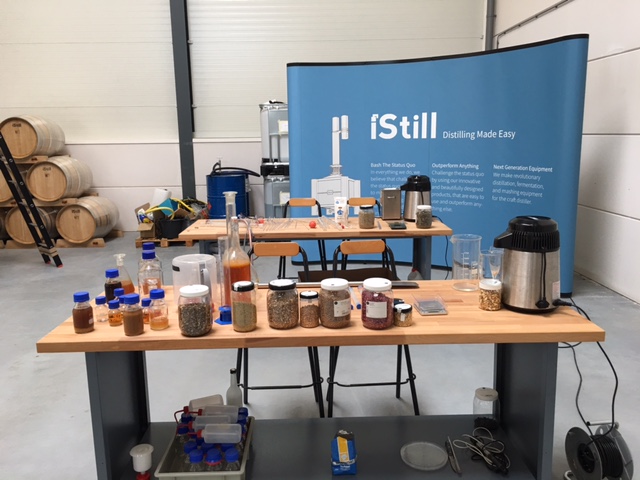
But that's not how we start. Recipe development at the iStill Laboratory starts in small glass fractionating stills, small glass extractors, and small stainless steel potstills. The goal is to make the first concept on a very small scale in order to come to a speedy assessment if we are on the right track. Speedy and at relatively low costs in terms of alcohol, energy, ingredients, and time consumption.
Does the first concept turn out as expected? In that case we'll dial things up a notch. Next thing we do is do a run in an iStill. We may tweak the recipe a bit still, but most of this second concept is about dialing in the right run procedure. How fast? What cut points for heads, hearts, and tails?
If we (and more importantly: you) are satisfied with the results, we go the next step: production procedure. How to mash and to ferment? How to use backset and/or dunder (if any)? On the grains, pulp, herbs, or not? Aging? These are examples of the questions we want to help answer for you.
Recipes are about ingredients, distillation run procedures, and production procedures. And how they help reach your initial goals. That last step is immensely important. It ties everything together and in general can mean the difference between an okay drink, and an award winning, above top shelf product.
Step by step
Step by step, the iStill spirits recipe design process looks like this:
- Goal formulation (what drink do you want to make and how should it taste?);
- First concept (where we design a recipe based on ingredients);
- Second concept (where we design the distillation run procedure);
- Third concept (where we design the most effective production process);
- Finalized recipe design (confrontation of third concept with original goals).
- Brandy (fruit brandies, brandy, cognac styles);
- Gin and genever (Dutch gin);
- Rum (light, middle, heavy, panella or molasse based);
- Vodka (rye, wheat, potato);
- Whisk(e)y (Irish, Bourbon, Single Malt);
- Extractions (fruits, herbs, nuts).
Distilling a first concept gin ...
www.iStill.eu